Exclusive Interview with Augustina “LUNARIA” Miknevičiūtė, 2nd Prize MPB Photography Award Beautiful Bizarre Art Prize 2025 by Samantha Dexter
A beautiful juxtaposition lies within LUNARIA’S body of work. Her photographs have a softness that usher in a sense of tranquility upon viewers yet a haunting chill sings upon the wind, lurks in the tall grass and melts into dark rivers. Her work blurs the lines between reality and an otherworldly realm where witches, folk horror and the forces of nature all come together to create something utterly captivating. Feminine figures become one with their surroundings and all of a sudden, gloomy lakesides, old wooden barns and lonesome bare trees take on a captivating warmth becoming backdrops for sweet and spooky fairytales.

Digital, Canon EOS 6D Mark II, Helios 44 -2.
Augustina Miknevičiūtė, known better in the photography world as LUNARIA, is a Lithuanian artist known for her atmospheric photographs that explore nature and people, with an emphasis on dreamlike aesthetics and mystical moods. Born in the village of Verebiejai, Lithuania, LUNARIA spent much of her childhood surrounded by nature which, in turn, has strongly influenced the direction of her artistic vision as a photographer. Her current body of work often explores motifs including nature, moonlight, and the night which gives her work a sense of quiet gothic mystery and an almost fairytale quality to it.
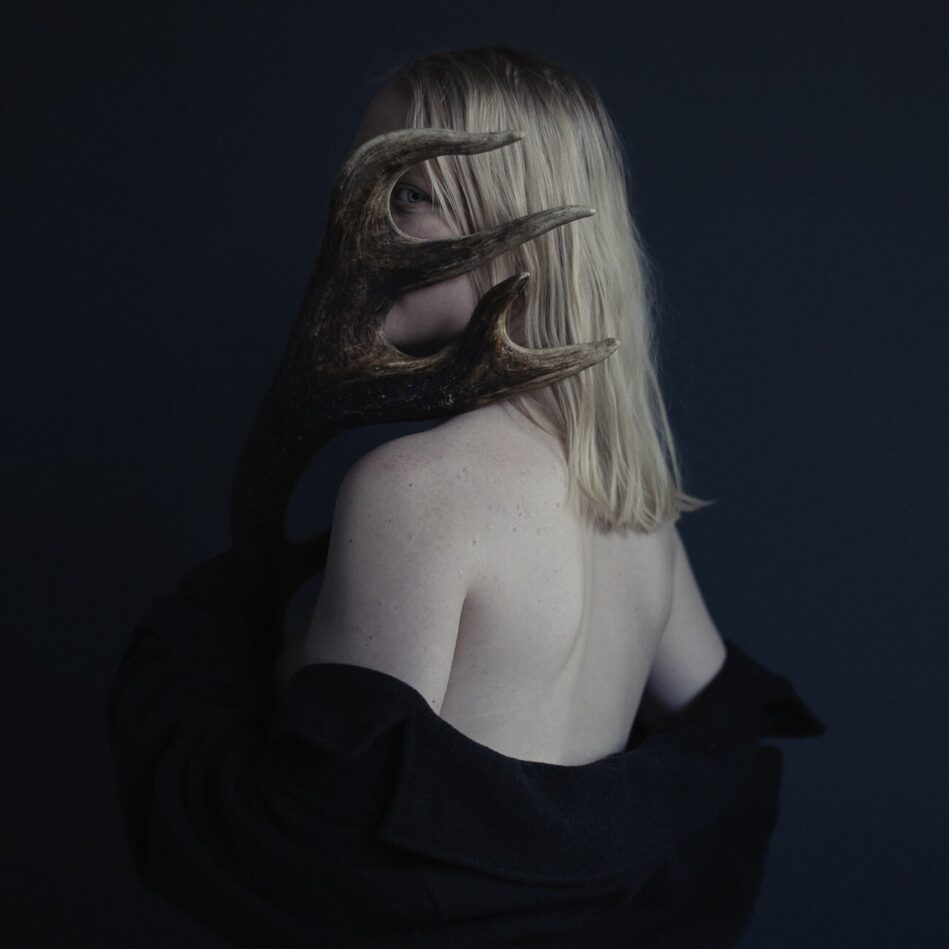
In 2025, LUNARIA found success in the Beautiful Bizarre Art Prize, winning the second prize in the MPB Photography Award with her photograph “Tenebris”.
Lunaria is also a member of the Beautiful Bizarre Artist Directory.
“Compared to the works of other creators, I think my pieces are very modest visually. They invite the viewer to look and delve deeper; there are no embellishments, and the atmosphere is shaped mostly by a calm human face or a chosen natural setting that, to my eye, carries a certain otherworldliness.”
Interview with Lunaria
First of all, I’d like to congratulate you on your success in the Beautiful Bizarre 2025 Art Prize! What was your first reaction when you found out the news on your success?
Thank you very much for the congratulations. Even just finding out that I made it into the group of 20 selected artists made me incredibly happy. I did think that it would be nice to progress further in the competition, but I certainly didn’t expect it. When I finally learned that I had won second place, I was overjoyed and couldn’t believe it for a long time. It feels like I still haven’t fully absorbed all of this joy even now.
Why did you enter the Beautiful Bizarre Magazine Art Prize?
I’ve been following Beautiful Bizarre Magazine for a very long time. I have a fascination for themes of fantasy and mysticism in art and so I decided to participate almost accidently after seeing the advertisement for this competition. I entered with the mindset of simply trying without expecting anything in return so when I submitted my piece “Tenebris” I even forgot about it.


What do you feel you have gained from this experience?
I have realised that I need to keep creating and to keep trying without being afraid to show my work. In the past, I wouldn’t usually participate in any kind of competition because I simply felt not as confident as other artists. Coming second place in the Beautiful Bizarre Art Prize has given me a lot of confidence in myself as a creator and in my work. It has reminded me that creativity, after all, is the most important thing to me.
Can you tell me a bit about your winning piece “Tenebris” and what this piece means to you as an artist?
Compared to the works of other creators, I think my pieces are very modest visually. This piece invites the viewer to look and delve deeper; there are no embellishments, and the atmosphere is shaped mostly by a calm human face or a chosen natural setting that, to my eye, carries a certain otherworldliness. “Tenebris” was born in a Lithuanian village called “Ąžuolų būda” (literally it could be translated as “Oak Hut”). A wonderful family has established a homestead here, with a wide range of animals and, most importantly, a strong, loving bond with all their creatures. In this environment we photographed my friend Samanta’s clothing collection. Her garments are inspired by Indian fashion and are colourful. If you look at my work, colour is quite rare, so I asked Samanta to put on my black coat and simply be still. We worked very briefly, considering that my creative processes usually take longer. At first, I didn’t pay much attention to this shot, but after reviewing it again and again, I understood that it held some hidden magic that I needed to reveal and show. This is how “Tenebris” was born.


What was the process like working on “Tenebris” and how did you find working with the horse featured? Did it make the shoot trickier than usual?
As I mentioned, the work itself really didn’t take long; my friend is very used to doing photoshoots with me, and so is the horse. After the photoshoot, there was another magical moment at night when we were walking through a frost-covered forest and he suddenly ran out of the darkness to accompany us. It felt like a dream, one I hope I never forget.
When looking at your body of work, the words gothic, witchy and folk horror spring to mind. What do you make of this interpretation? Does it align with how you see your work as an artist?
I am very glad to hear this interpretation about my work. Here in Lithuania, this feeling or stylistic direction is not very common in other photographers’ works, so to me it sounds like a lovely distinctiveness, the greatest compliment. Since I grew up near marshes and my grandparents used to tell me various Lithuanian folk tales from childhood – which, by the way, are not very happy but rather eerie and instructive, about witches, laumės, and so on – it seems this settled in my heart as a sensitive child and eventually emerged in my work as one of its essential themes or emotions.


Who/what inspires you?
Fields passing by through the bus window, the night, music, people, conversations… Everything around is an inspiration; you just need to allow yourself to pause and feel it.
Would you recommend the Beautiful Bizarre Art Prize and encourage others to enter? If so, why?
Of course, I would recommend it. Why not give it a try? A creator really has nothing to lose, and by visiting the magazine’s website or social media, they will definitely get inspired and enjoy the work and stories of other artists.
What is the most rewarding part of your photography work and why?
You don’t need to carry all your emotions inside—you can capture them in a frame. It’s really fun to create your own world this way, especially when reality isn’t always enough. It’s also a joy to share it with others; sometimes creativity works like telepathy. It clarifies the audience, and those who are truly “yours” appear alongside it.


What advice would you give to aspiring artists and photographers?
I would advise to keep creating and never stop. In every possible way, search for yourself and your style, don’t be afraid to experiment, and keep trying. In the end, everything will fall into place.
What can our readers hope to see from you moving forward?
I hope to dedicate even more time to my creativity, finally leave the job I’ve been at for nine years, and spend at least a couple of months fully immersed in exploration and photography. Those are my current aspirations.